
Florida Motorcycle Handbook: Know your Motorcycle
4. Preparing to Ride
KNOW YOUR MOTORCYCLE
There are plenty of things on the highway that can cause you trouble. Your motorcycle should not be one of them. To make sure that your motorcycle won't let you down:
- Read the owner's manual first.
- Start with the right motorcycle for you.
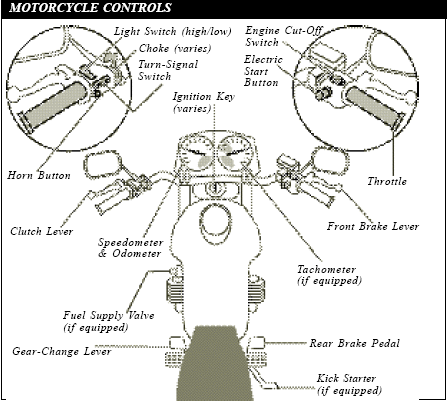
- Be familiar with the motorcycle controls.
- Check the motorcycle before every ride.
- Keep it in safe riding condition between rides.
- Avoid add-ons and modifications that make your motorcycle harder to handle.
THE RIGHT MOTORCYCLE FOR YOU
First, make sure your motorcycle is right for you. It should "fit" you. Your feet should be flat on the ground while you are seated on the motorcycle.
At minimum, your street-legal motorcycle should have:
- Headlight, taillight and brakelight.
- Front and rear brakes.
- Turn signals.
- Horn.
- Two mirrors.
4.3.1 - BORROWING AND LENDING
Borrowers and lenders of motorcycles, beware. Crashes are fairly common among beginning riders - especially in the first months of riding. Riding an unfamiliar motorcycle adds to the problem. If you borrow a motorcycle, get familiar with it in a controlled area. If you lend your motorcycle to friends, make sure their license is motorcycle endorsed and they know how to ride before allowing them out into traffic.
No matter how experienced you may be, ride extra carefully on any motorcycle that's new or unfamiliar to you. More than half of all crashes occur on motorcycles ridden by the operator for less than six months.
GET FAMILIAR WITH THE MOTORCYCLE CONTROLS
Make sure you are completely familiar with the motorcycle before you take it out on the street. Be sure to review the owner's manual. This is particularly important if you are riding a borrowed motorcycle. If you are going to use an unfamiliar motorcycle:
- Make all the checks you would on your own motorcycle.
- Find out where everything is, particularly the turn signals, horn, headlight switch, fuel-control valve, and engine cut-off switch. Find and operate these items without having to look for them.
- Know the gear pattern. Work the throttle, clutch, and brakes a few times before you start riding. All controls react a little differently.
- Ride very cautiously and be aware of surroundings. Accelerate gently, take turns more slowly, and leave extra room for stopping.
4.3.2 - CHECK YOUR MOTORCYCLE
A motorcycle needs more frequent attention than a car. A minor technical failure in a car seldom leads to anything more than an inconvenience for the driver.
If something's wrong with the motorcycle, you'll want to find out about it before you get in traffic. Make a complete check of your motorcycle before every ride.
Before mounting the motorcycle, make the following checks:
- Tires - Check the air pressure, general wear and tread.
- Fluids - Oil and fluid levels. At a minimum, check hydraulic fluids and coolants weekly. Look under the motorcycle for signs of an oil or gas leak.
- Headlights and Taillight - Check them both. Test your switch to make sure both high and low beams are working.
- Turn Signals - Turn on both right and left turn signals. Make sure all lights are working properly.
- Brake Light - Try both brake controls, and make sure each one turns on the brake light.
Once you have mounted the motorcycle, complete the following checks before starting out:
- Clutch and Throttle - Make sure they work smoothly. The throttle should snap back when you let go. The clutch should feel tight and smooth.
- Mirrors - Clean and adjust both mirrors before starting. It's difficult to ride with one hand while you try to adjust a mirror. Adjust each mirror so you can see the lane behind and as much as possible of the lane next to you. When properly adjusted, a mirror may show the edge of your arm or shoulder - but it's the road behind and to the side that's most important.
- Brakes - Try the front and rear brake levers one at a time. Make sure each one feels firm and holds the motorcycle when the brake is fully applied.
- Horn - Try the horn. Make sure it works.
In addition to the checks you should make before every trip, check the following items at least once a week: Wheels, cables, fasteners, and fluid levels. Follow your owner's manual to get recommendations.
4.3.3 - KNOW YOUR RESPONSIBILITIES
"Accident" implies an unforeseen event that occurs without anyone's fault or negligence. Most often in traffic, that is not the case. In fact, most people involved in a crash can usually claim some responsibility for what takes place.
Consider a situation where someone decides to try to squeeze through an intersection on a yellow light turning red. Your light turns green. You pull into the intersection without checking for possible latecomers. That is all it takes for the two of you to tangle. It was the driver's responsibility to stop. And it was your responsibility to look before pulling out. Neither of you held up your end of the deal. Just because someone else is the first to start the chain of events leading to a crash, it doesn't leave any of us free of responsibility.
As a rider you can't be sure that other operators will see you or yield the right of way. To lessen your chances of a crash occurring:
- Be visible - wear proper clothing, use your headlight, ride in the best lane position to see and be seen.
- Communicate your intentions - use the proper signals, brake light and lane position.
- Maintain an adequate space cushion - following, being followed, lane sharing, passing and being passed.
- Scan your path of travel 12 seconds ahead.
- Identify and separate multiple hazards.
- Be prepared to act - remain alert and know how to carry out proper crash-avoidance skills.
Blame doesn't matter when someone is injured in a crash. There is rarely a single cause of any crash. The ability to ride aware, make critical decisions, and carry them out separates responsible riders from all the rest. Remember, it is up to you to keep from being the cause of, or an unprepared participant in, any crash.
Check out our Customer Reviews!